
A lower monthly payment can still cost more over time. The options for consolidating loans from different states include a debt consolidation loan or a balance-transfer card, which may combine eligible balances into one payment. A consolidation loan may have an origination fee, so review the terms for prepayment penalties and how extra payments affect your payoff. Compare the rate, fees, monthly payment, and repayment term before choosing.
It makes sense to want fewer due dates and a clearer path out of debt. But the payment amount alone doesn’t show what you’ll pay in total, especially when a lower payment comes with a longer repayment period or a promotional rate that later increases.
This guide explains how to compare consolidation options when loans come from different states, what fees and payoff terms to review, and how rates affect total cost. You’ll also learn how to assess payments against your budget and when payday loan consolidation may be a more relevant way to manage multiple high-interest payday loans.
Key Takeaways
- Compare the APR, fees, and full repayment term, not just the advertised monthly payment, to understand the loan’s total cost.
- Review the agreement for origination charges, promotional-rate changes, and any prepayment penalty before consolidating.
- Make sure the new payment fits your budget while leaving room for essential expenses and unexpected costs.
- Check how the new loan handles debts from different states and confirm which balances will be paid off through consolidation.
- If payday loans are the main burden, explore whether payday loan consolidation could make repayment more manageable.
Debt consolidation loan APRs and qualification factors
For loans from different states, compare each balance and the terms available for consolidating it. APR, income, credit history, and lender coverage can all affect your options.
A debt consolidation loan can combine several debts into one payment, but a lower payment alone doesn’t make it a better deal. Compare the APR, repayment period, fees, and total amount due over the full loan term.
Comparing APR and Repayment Costs
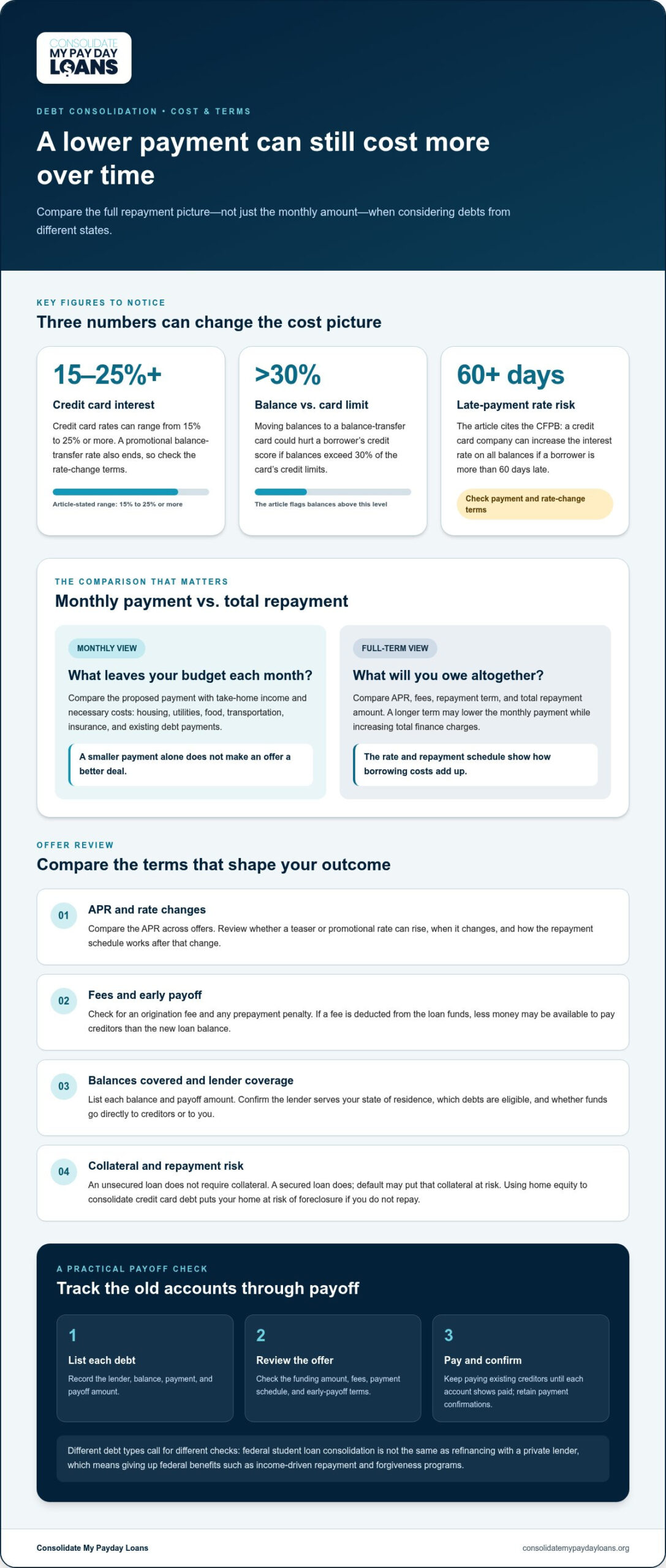
Compare offers side by side, including APR, monthly payment, and total repayment cost. The APR reflects borrowing costs, while the payment and term show how those costs add up. A longer term may lower the monthly payment but increase total finance charges.
Some loans have teaser rates that can rise after a set period. Credit card interest rates can range from 15% to 25% or more, and promotional balance-transfer rates also end. Read the rate-change terms alongside the repayment schedule before choosing.
For medical debt, identify the provider, outstanding balance, and any existing payment arrangement. A consolidation loan creates a separate obligation, so consider whether including that balance improves your overall repayment plan.
Consolidation can affect credit because a new application and account change your credit profile. Moving credit card balances to a balance-transfer card could hurt a borrower’s score if those balances exceed 30% of the card’s credit limits. According to the Consumer Financial Protection Bureau, a credit card company can increase the interest rate on all balances if a borrower is more than 60 days late on a payment.
Loan Qualification and Residency Limits
Lenders commonly assess credit history, income, existing debt, and the requested amount when reviewing an application. Your state of residence and the lender’s coverage can also limit available offers. Compare offers that accept your state of residence and account for debts held in other states.
When comparing debt consolidation companies, review the APR, fees, repayment terms, and how funds reach creditors. A personal loan may pay eligible creditors directly or give you funds to pay them yourself. Confirm which balances are included, and keep making existing payments until each creditor confirms the account is paid.
Federal student loan consolidation combines multiple federal loans into one Direct Consolidation Loan. Refinancing federal student loans with a private lender means giving up federal benefits such as income-driven repayment and forgiveness programs. These options serve different purposes, so distinguish federal student loans from credit card balances or medical bills before applying.
Do debt consolidation loans have fees or prepayment penalties?
To consolidate loans from different lenders or states, list each balance, request a payoff amount, and compare consolidation offers. If you choose a loan, use its funds to pay the included creditors, then confirm each old account reflects the payment.
A debt consolidation loan can combine several debts into one loan or line of credit. This can simplify monthly payments, but it doesn’t erase what you owe. Your new payment depends on the amount consolidated, APR, and repayment term. Check the agreement for origination fees and any prepayment penalty.
Read the loan disclosure before accepting an offer. Review the amount financed, payment schedule, total repayment amount, fees, and early-payoff terms. If an origination fee is deducted from the funds, you may have less available to pay creditors than the new loan balance. Account for that difference when deciding which debts to include.
Combining unsecured debts can replace separate due dates with one scheduled payment. Credit cards and other unsecured accounts don’t require collateral, but balances must meet the lender’s eligibility rules. List each creditor, account balance, minimum payment, and payoff amount. Compare that list with the new loan’s funding amount to see whether it covers every account you intend to include.
Keep paying existing creditors until their accounts show paid. Processing delays can leave a balance due, and a missed payment can add fees or affect your credit score. After payoff, review each statement and keep the lender’s payment confirmations. If an account remains open, decide whether to keep or close it based on your budget and account terms.
Secured and unsecured loans carry different risks. An unsecured consolidation loan doesn’t require collateral. A secured loan does, such as a car-secured loan, and the lender may take the collateral after default. Using home equity to consolidate credit card debt also puts your home at risk of foreclosure if you don’t repay.
- List the debts: Record each lender, balance, payment, and payoff amount.
- Review the offer: Compare its funding amount, fees, schedule, and early-payoff terms.
- Pay and confirm: Track each creditor’s account until the payoff appears.
If high-interest payday loans are the debts you’re combining, review how payday loan consolidation addresses multiple payments. Choose an approach that accounts for every balance without putting essential collateral at unnecessary risk.
Budget and affordability considerations
Before accepting a debt consolidation loan, test the payment against your actual monthly budget. Aim for a payment you can manage while covering essentials, not simply a smaller number in a lender’s offer.
Start with take-home income and list necessary expenses, including housing, utilities, food, transportation, insurance, and existing debt payments. Compare what remains with the proposed consolidation payment. Account for less frequent costs, such as annual premiums or car repairs, by setting aside part of your income each month.
A debt-to-income ratio can help show how much income already goes toward debt. For example, monthly debt payments of $1,500 against gross monthly income of $5,000 produce a 30% ratio. Use your own figures to understand your starting point, then check how the new payment changes that picture. Lenders may also consider income and existing obligations when reviewing an application.
Don’t assume a lower required payment means the plan fits your budget. Compare the new payment with what remains after essentials and savings for irregular expenses. A longer repayment period can reduce the monthly amount while increasing the total paid. If the payment leaves no room for an unexpected bill, the plan may strain your finances even if it replaces several due dates.
Credit card minimums can also hide how long repayment may take. A 2% minimum payment on a $1,000 balance equals $20. Paying only that minimum can keep the balance active, while a consolidation loan shifts repayment to a set schedule. Compare the required payment with an amount you can sustain, and account for the loan’s full term rather than relying on the first month’s budget.
Consider what happens to balances after consolidation. If you keep charging purchases to paid-down credit cards, you could end up with both the loan payment and new card debt. Build a spending plan that covers routine expenses without relying on those cards. A consolidation loan doesn’t address spending that exceeds your income unless you reduce spending or increase income.
Home equity involves a separate budget trade-off. Using it to consolidate credit card debt may leave less equity available for emergencies, repairs, or renovations. Compare that reduced flexibility with the payment schedule and collateral risk before using your home.
If payments feel tight before you apply, contact individual creditors to ask about lower payments, waived fees, reduced interest, or changed due dates. Compare each response with your proposed loan terms. A creditor’s adjustment may ease pressure without adding a new account or charge, while you can still compare a consolidation loan against those revised balances.
Fixed payments, interest rates, and payoff terms
A predictable payment can make repayment easier to plan, but the interest rate and payoff term determine its cost. Compare each option’s schedule, including whether the rate is fixed or can change, how much of each payment goes toward interest, and when the balance will reach zero.
A lower monthly payment may result from extending repayment rather than reducing the interest rate. A longer term can increase the total paid, even if each payment feels more manageable. Compare the full repayment amount and payoff date, then decide whether the lower monthly payment is worth carrying the debt longer.
Balance-transfer cards work differently from personal loans. A card may offer a 0% introductory interest rate for 12 to 18 months, but its rate can rise when the promotional period ends. After that period, the rate is often 20% or higher. Estimate whether you can pay the transferred balance before the offer expires, and include the transfer fee in your comparison.
For federal student debt, a Direct Consolidation Loan uses the weighted average of existing federal loan rates. Consolidation therefore doesn’t lower the overall interest rate. It combines eligible federal loans into one loan, while refinancing federal loans with a private lender means giving up federal benefits such as income-driven repayment and forgiveness programs.
Personal loan terms vary by lender and offer. Discover personal loans for debt consolidation have repayment terms of 36 to 84 months. Use the term to compare the scheduled payment and total repayment amount, rather than assuming a longer schedule is cheaper. A fixed rate can make payments predictable; a variable rate can change the amount owed over time.
Debt consolidation programs may take 3-to-5 years. Compare that timeline with a personal loan’s stated payoff schedule and your own ability to make each payment. A program or loan that lowers the monthly amount but extends repayment can keep interest accruing for longer.
Before choosing, write down these details for each offer:
- Rate: Record the starting interest rate and any stated change after a promotional period.
- Payment: Note the required amount and whether it can change during repayment.
- Payoff: Record the repayment term, expected total repayment, and any early-payment conditions.
Compare the offers with your existing payoff schedules. A lower interest rate can help only if fees, term length, and payment timing don’t offset the savings. Keep federal student loans separate in your comparison because their consolidation rules and benefits differ from those of private personal loans.
Origination fees and total borrowing costs
An advertised interest rate doesn’t show the full cost of consolidation. Debt consolidation loans may include origination fees that reduce the funds available to pay creditors. Compare the amount borrowed with the amount disbursed, then calculate scheduled payments and total repayment over the full loan term.
Check how the loan agreement handles any fee. A lender may deduct it from the proceeds or add it to the amount financed. Account for it alongside interest and the repayment schedule. If the net proceeds don’t cover every balance you intend to pay, you could still owe an old creditor after taking on the new personal loan.
Use one comparison sheet for each offer. Record the APR, any origination fee, net funds, monthly payment, repayment term, and total scheduled payments. Include any early-payoff charge stated in the agreement. Then compare the full cost with continuing to repay current accounts, using their actual balances and payoff terms.
Balance transfers have a separate fee structure. Fees are usually 3% to 5% of the transferred amount. They’re commonly calculated as a percentage or fixed amount, whichever is more. Include that fee in your total, even if a credit card advertises a 0% introductory rate. The promotional period is limited, and the rate may rise afterward, so estimate how much you can pay before it ends.
A minimum payment can make a balance transfer seem manageable while leaving much of the balance unpaid. Check the card’s payment rules and avoid new purchases until you understand how interest applies. New purchases may not receive a grace period during a balance transfer and could accrue interest until the full balance is paid.
Home equity involves costs and risks beyond the interest rate. Closing costs for a home equity loan can be hundreds or thousands of dollars. Using home equity may also leave less available for emergencies or repairs. If home values fall, you could owe more than your home is worth, making a sale or refinance harder. Your home is also at risk of foreclosure if you don’t repay.
The Truth in Lending Act (TILA) helps consumers compare credit terms and make informed decisions. Use the disclosures to identify fees, payment timing, and total cost. A lower rate can still result in higher finance charges if the new term is longer.
For a clearer comparison, total the fees and scheduled payments for each offer, then set that amount beside the cost of keeping the current debts. If high-interest payday balances are central to your calculation, review a focused consolidation option as part of your cost comparison.
Consolidate My Payday Loans: Payday Loan Consolidation
Consolidate My Payday Loans provides Payday Loan Consolidation for borrowers managing multiple high-interest payday loans. If separate due dates and payments are making repayment difficult, consolidation can bring those loans into a single payment. Its payday loan relief programs are designed to help break the debt cycle and lower monthly payments.
The Payday Loan Consolidation Calculator can help estimate potential savings and debt reduction as you review your situation. This service focuses on payday loan debt, while Credit Card Consolidation is available for credit card balances. Compare payment terms with your budget and consider whether this support fits the debts you need to address.
Contact Consolidate My Payday Loans to discuss your payday loan consolidation options.
Take the Next Step Toward a Manageable Plan
Choose a next step that turns your comparison into a practical plan. Gather your current statements and identify which balances are payday loans, credit cards, or other debts. This simple inventory can help you focus on the obligations causing the most pressure and decide what kind of support may fit.
Among the options for consolidating loans from different states, the right path depends on the debts you’re addressing and the payment structure you can manage. Consolidate My Payday Loans offers payday loan relief for borrowers looking for a way forward from recurring payday debt. Its calculator can help estimate potential savings and debt reduction as you consider your next step.
If payday loans are weighing on your budget, take a calm, informed step toward exploring support. Contact Consolidate My Payday Loans to discuss your situation and available options. A clear plan can help you move forward with greater confidence.
Frequently Asked Questions
What kind of debts can you consolidate?
Depending on the lender and program, you may be able to consolidate credit card balances, personal loans, payday loans, or other unsecured debts. Medical debt may also qualify for some repayment arrangements, but it isn’t automatically eligible for every loan. Make a list of your debts, including each creditor, balance, and account type. That inventory helps you identify which obligations a specific consolidation option can address.
How can a debt consolidation loan help you reach your goals?
A debt consolidation loan can support goals such as replacing several due dates with one scheduled payment or creating a defined repayment timeline. It doesn’t remove the debt, and it won’t address a recurring budget shortfall by itself. For example, if credit card spending continues after consolidation, new balances can build alongside the loan. Pair the repayment plan with a spending approach that avoids relying on newly available credit.
How is my interest rate determined?
A lender sets your offered interest rate using factors such as credit history, income, existing debt, and loan terms. The same applicant can receive different offers because lenders assess risk and structure products differently. Compare the APR and rate-change conditions, not just the starting rate. For example, a promotional card rate may change after the offer period, while a fixed-rate personal loan keeps the stated rate throughout repayment.
What types of loans can be consolidated together in the U.S.?
Personal loans may be used to consolidate eligible unsecured debts, such as credit card balances or other personal loans, subject to the lender’s terms. Federal student loans can be combined through a federal Direct Consolidation Loan. This differs from combining private debt, and federal loans shouldn’t be treated as interchangeable with credit cards. Identify each loan type and whether it is federal or private before comparing ways to combine balances.
How do debt consolidation loan eligibility requirements vary by lender and state?
Eligibility can depend on your credit profile, income, current obligations, requested amount, and the lender’s available products. Your state of residence may also affect which lenders or loan terms are available. When comparing options to consolidate loans from different states, distinguish where you live from where each debt originated, then assess offers against your residence and each lender’s eligibility rules.
Does consolidating loans affect credit scores, taxes, or borrower protections?
Applying for a new account and changing how balances are reported can affect your credit profile. Consolidation is different from debt forgiveness, so don’t assume it cancels what you owe. Tax treatment can depend on whether any debt is forgiven. Refinancing federal student loans with a private lender means giving up federal benefits, including income-driven repayment and forgiveness programs.